
Tuckman’s Stages of Team Development: A Guide for New Executive Teams
As executives, stepping into a leadership team often involves navigating the complexities of group dynamics while driving strategic objectives.
To aid in this journey, Tuckman’s model of team development serves as a valuable framework.
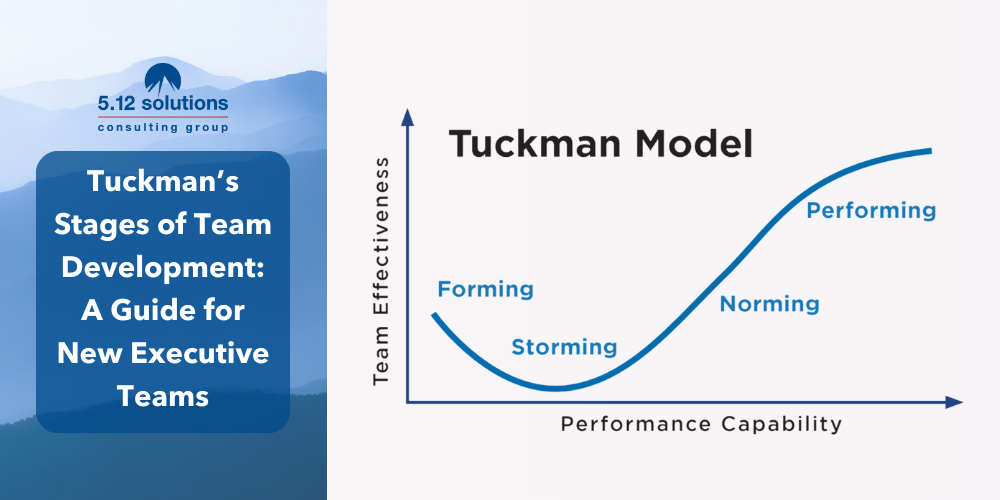
Developed by psychologist Bruce Tuckman in 1965, this model outlines four critical stages — Forming, Storming, Norming, and Performing — that teams typically go through to achieve high performance.
Understanding each stage can help executives foster a more effective and collaborative environment.
Here is an exploration of each phase tailored for a newly formed leadership team…
#1 – Forming
Observable Behaviors:
- Members are polite and positive.
- There’s a general sense of excitement and anticipation about the future.
- Roles and responsibilities are unclear.
- Leaders are often seen as the ultimate authorities.
Team Needs:
- Clear structure and direction.
- Understanding of the team’s goals and objectives.
- Assurance about the safety and structure within the team.
Leadership Required:
- Directive leadership is crucial.
- Leaders should focus on providing clear guidance and expectations.
- Establishing processes and assigning roles will help in mitigating uncertainty.
#2 – Storming
Observable Behaviors:
- Conflict arises over unclear roles and personal differences.
- Cliques may form, and there may be challenges to authority.
- There’s a struggle as members try to establish a pecking order.
Team Needs:
- Conflict resolution mechanisms.
- Greater trust and respect among members.
- Reaffirmation of team goals and a focus on organizational objectives.
Leadership Required:
- Participative leadership can be beneficial here.
- Leaders need to be adept at conflict management and must foster open communication.
- Encouraging team engagement without choosing sides and promoting inclusive decision-making is key.
#3 – Norming
Observable Behaviors:
- The team starts to develop its own identity.
- There’s a rise in team spirit as relationships become more cooperative.
- Members adjust their behaviors to support the team.
Team Needs:
- Continued support in operationalizing workflows and processes.
- A strong focus on relationship-building and strengthening the team’s cohesion.
Leadership Required:
- Coaching-style leadership helps here.
- Leaders should empower members and encourage ownership.
- Focus shifts from individual accomplishments to team outcomes.
#4 – Performing
Observable Behaviors:
- The team is now strategically aware and knows clearly what it is doing.
- Members have a shared vision and are able to function autonomously.
- There is a high degree of interdependence in problem-solving.
Team Needs:
- Autonomy from the leader to make decisions.
- Continued opportunities for growth and innovation.
Leadership Required:
- Delegative leadership is predominant in this stage.
- Leaders should oversee progress and provide resources, stepping in only when needed.
- It’s important to challenge the team to continue improving and to celebrate successes to boost morale.
Leading through Each Phase of the Model
For an executive leadership team to effectively apply Tuckman’s stages, proactive measures tailored to each phase are essential.
- During the Forming stage, leadership can facilitate ice-breaking activities and in-depth onboarding sessions to cultivate familiarity and define objectives clearly, setting a strong initial direction.
- As the team transitions to the Storming phase, it is critical to establish regular feedback mechanisms and conflict resolution strategies that encourage open dialogue and address any interpersonal or task-related conflicts early on. This helps to prevent festering issues and aligns the team towards common goals.
- In the Norming stage, leaders should promote team-building exercises that enhance trust and collaboration, and implement regular review sessions to reinforce roles, responsibilities, and the progress towards the team’s objectives.
- Finally, in the Performing stage, maintaining high performance can be achieved by setting challenging team goals, fostering innovation through autonomy, and encouraging continuous professional development. Leadership should focus on recognizing achievements, which not only enhances morale but also pushes the team to innovate and improve continuously. Using this model as a roadmap, executive teams can navigate the complex dynamics of team formation and lead their teams to high efficiency and effectiveness.
The Fluidity of Tuckman’s Model
It is important to recognize that Tuckman’s stages of team development are not necessarily linear. Teams may experience setbacks and can regress to earlier stages as new challenges arise or team dynamics shift. For example, the addition of a new team member or a sudden shift in project direction can push a team from Norming back into Storming. This cyclical nature underscores that an executive team is fundamentally a group of individuals in a dynamic relationship with each other. These relationships require constant nurturing and attention.
For executive leaders, it is essential to continually invest in relationship-building and conflict resolution to optimize the team’s human performance. Acknowledging and addressing the fluidity of these stages can help maintain a focus on collective growth and adaptation, ensuring the team remains resilient and effective even as circumstances change.
Conclusion
For executives, understanding and guiding their teams through these stages is crucial to developing a cohesive and efficient team. Each stage of Tuckman’s model presents unique challenges and requires specific leadership styles and strategies.
By recognizing the characteristics and needs of each stage, leaders can effectively steer their teams toward sustained performance and success. This framework not only helps in smoothing transitions but also in accelerating the team’s ability to achieve organizational goals.
As you embark on this journey with your new team, leverage these insights to build a robust foundation for your collective success.
Ready to elevate your executive team’s performance? Sign up for a free insight session today and work with us to unlock your team’s full potential.
Sources:
Tuckman, Bruce W. (1965). Developmental Sequence in Small Groups. Psychological Bulletin, 63, 384-399. This paper is where Tuckman first introduced his stages of group development: Forming, Storming, Norming, and Performing.
Tuckman, Bruce W., and Mary Ann C. Jensen. (1977). Stages of Small-Group Development Revisited. Group & Organization Studies, 2(4), 419-427. In this follow-up study, Tuckman revisits and extends his original model to include a fifth stage, Adjourning, discussing the dissolution of the group.